

By Alexandre Tsuk, founder of BreathingCold. Last updated October 2026.
The short answer: Start with water around 15°C (59°F), stay in for one to two minutes, and do it two or three times a week. Enter slowly, keep your breathing calm and slow, and never do it alone. Research on regular cold exposure points to roughly 11 minutes in total per week as enough to see measurable effects in healthy people, so more is not better. And some people should skip it entirely, which I cover below.
Why most beginners get it wrong
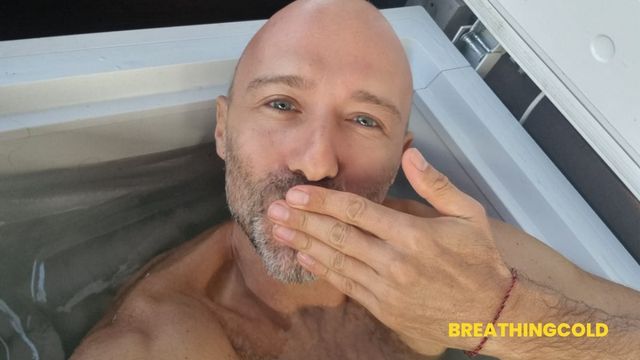
The internet sells ice baths as a test of toughness: colder, longer, harder. That is backwards for your first month. The first minute in cold water is the dangerous part, not the last. The body’s first reaction, called the cold shock response, is an involuntary gasp, a burst of fast breathing, a racing heart and a spike in blood pressure. In people with an undiagnosed heart rhythm problem, that reaction is where the risk sits.
The good news is that your body adapts quickly. A meta-analysis of the research found the cold shock response fades after about four immersions. So your first week is not about benefit. It is about teaching your nervous system that cold water is not an emergency.
When I started with ice baths I loved it right away. After a few weeks I felt huge resistance and stopped for almost six months. For me, the ice bath is an incredible teacher. I learned to listen to my body more, to trust when to do it and when not to, and to tell the difference between fear and danger, resistance and self-awareness. Now I take about three ice baths a week, usually around 10°C, for about five minutes at a time. That comes from years of practice, so it is not where you should begin. Start with the plan below.
Who should not do an ice bath
Talk to a doctor first, or skip it, if any of this applies to you:
- A heart condition, a rhythm disorder, or a family history of sudden unexplained cardiac death
- High blood pressure that is not well controlled
- Cold urticaria (hives from cold)
- Pregnancy
- Circulation problems in your hands or feet
Medical screening guidance for cold water immersion lists cardiac history and cold urticaria among the main risk factors. If you are not sure, ask a doctor before you start. A cold shower is a gentler way to test your response.
The first-month protocol
Week 1: Cold showers. Finish your normal shower with 30 to 60 seconds of cold. Focus on slow breathing out through the mouth. Do this three times.
Week 2: First immersion. Fill a tub or use a plunge at around 15°C (59°F). Lower yourself in slowly. Do not jump or dive. Keep your head and face out of the water. Stay one minute, breathing slowly, then get out. Do this two or three times during the week.
Week 3: One to two minutes. Same temperature. Build to about two minutes if your breathing stays calm. If you notice yourself gasping or panicking, get out. That is information, not failure.
Week 4: Settle your routine. Two or three short sessions a week. The research behind the 11-minutes-per-week figure used short sessions spread across two to three days, not one long session. You can lower the temperature gradually, but you do not need near-freezing water to benefit.
The BreathingCold approach: get out of the way
At BreathingCold, an ice bath is not a test of control. It is practice in letting go of it.
Get out of the way when you enter. Go in slowly, as described above, then stop managing the experience. Give yourself full permission to scream, laugh or cry if it comes. Emotions we have held back often sit close to the surface in cold water. Let them move through instead of clamping down. Keep your exhale long, and if your breathing turns fast and out of control, slow it down or get out.
Feel the resistance and do it anyway. The resistance you feel before getting in is useful. It is one of the best anti-procrastination practices I know: notice the pull to put it off, and do it anyway. Resistance is not always a green light, though. Learn the difference between fear, which you can move through, and danger, which means stop.
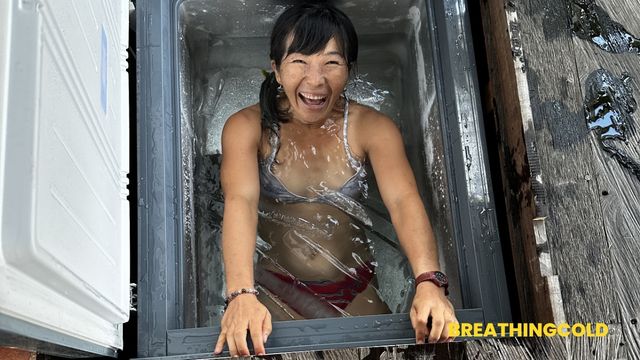
Let yourself shiver. I love allowing the shivers. Because the air in Bali is warm, it is safe to let the body shake after you get out. To me it feels like stored tension in the fascia letting go. Science on fascia release is limited, but shivering is simply your body warming itself, and it is fine to let it happen. If the shaking becomes violent, you feel confused, or you cannot use your hands, get out and rewarm.
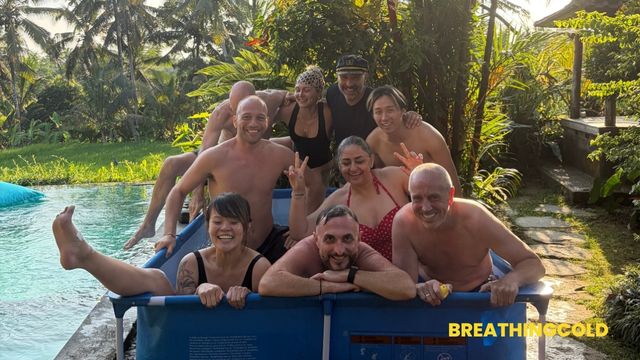
Ask for support. My main lesson was to ask for help from inside the water when it gets too much. Looking at someone and asking for emotional support was a game changer. Before, I did everything alone and saw asking for help as weakness. This is also why you should never do it alone.
Your breathing matters more than the temperature
This is where our work with breathwork comes in. In the water, your job is to slow everything down: a long, soft exhale, shoulders dropping, jaw loose. Do not force a breathing pattern.
One firm rule: never do fast or deep hyperventilation-style breathing before or during an ice bath. It can lower carbon dioxide enough to cause fainting, and fainting in water is dangerous. Do any intense breathwork on its own, on dry land, and keep cold exposure for a separate session. I explain how to combine the two safely in a separate article.
Safety rules
- Never go alone, especially in your first weeks.
- Never do it after alcohol.
- Get in slowly and keep your face out of the water.
- Get out if you feel dizzy, confused, or lose feeling in your hands.
- Rewarm gently afterwards with dry clothes and movement. Avoid very hot showers straight away.
- Open water is a different level of risk from a tub. Build experience in controlled conditions first.
What you can realistically expect
People report feeling alert, calm and proud after a session. Some research shows regular cold exposure may support brown fat activity and insulin sensitivity, though that work was done in healthy participants and the evidence for many other claims is thinner. I would rather tell you that than oversell it. Treat cold exposure as a practice for nervous system resilience and self-trust, not a cure.
Frequently asked questions
How cold should an ice bath be for a beginner? Around 15°C (59°F). Water at 15°C or below is generally counted as cold water immersion, and beginners do not need to go colder.
How long should a beginner stay in? One to two minutes. Total time matters more over the week than any single session.
How often should I do it? Two or three times a week. About 11 minutes in total across a week is the amount studied in healthy people.
Is a cold shower as good as an ice bath? A cold shower is a legitimate way to start and builds the same tolerance. An immersion is a stronger stimulus, so keep it for after you are comfortable with showers.
Can I combine breathwork and ice baths? Yes, but separately. Do not hyperventilate before or during immersion.
Is it okay to shiver, scream or laugh in an ice bath? Yes. Shivering is your body warming itself, and laughing, screaming or crying are normal emotional releases. Keep your exhale long and your breathing under control. If you feel confused, lose the use of your hands, or cannot calm your breathing, get out and ask for help.
Try it with guidance
If you would rather learn this with someone experienced next to you, join us in Ubud or Join the Ice Bath Facilitator Training ONLINE.
See our upcoming experiences or reach out for a private session: BreathingCold
—————
Sources used
- Tipton (1989), The initial responses to cold-water immersion in man, Clinical Science
- Tipton et al. (2017), Cold water immersion: kill or cure?, Experimental Physiology
- Barwood et al. (2024), Habituation of the cold shock response: a systematic review and meta-analysis, Journal of Thermal Biology
- Shattock and Tipton (2012), Autonomic conflict: a different way to die during cold water immersion?
- University of Portsmouth, Cold water therapies: minimising risks
- Søberg et al. (2021), Cell Reports Medicine, and Dr Susanna Søberg’s published interviews on the 11-minute weekly protocol