
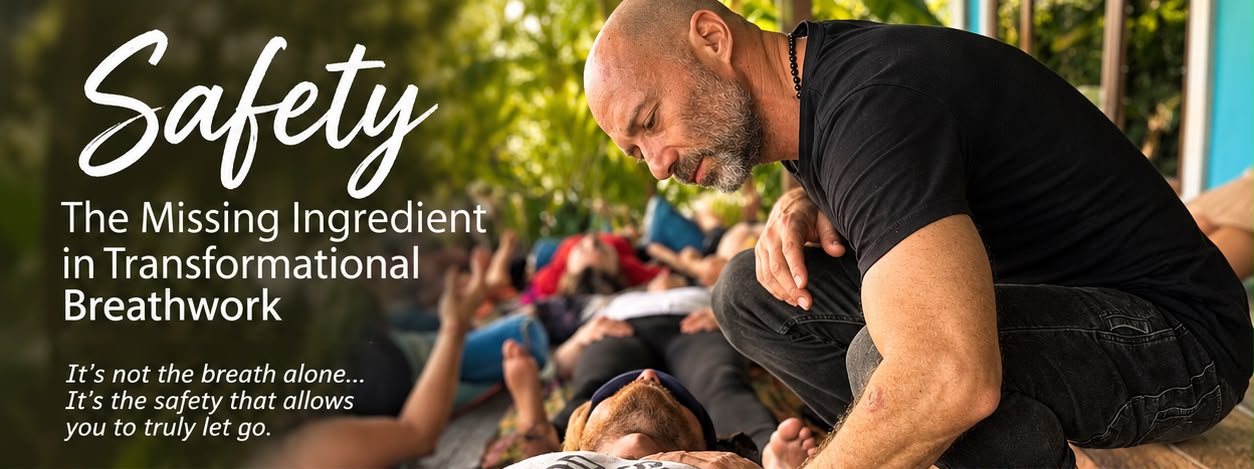
It’s not the music, the breathing technique or the perfect prompt that makes a Breathwork session transformational. It’s the safety that allows people to finally let go of the armour they’ve been wearing for most of their lives.
When we talk about Breathwork, most of the attention goes to the breathing technique itself.
What breathing pattern should we use? What music will take people on an emotional journey? What words or prompts will help them access deeper layers of themselves?
These things matter. But I believe we often overlook the most important ingredient of all: safety.
Because the real transformation doesn’t happen simply because someone breathes deeply or intensely.
It happens when someone finally feels safe enough to stop protecting themselves.
The armour we’ve learned to wear
Most of us have spent a lifetime learning how to protect ourselves.
We develop masks, boundaries, defence mechanisms and emotional shields. We learn to hide certain parts of ourselves because, somewhere along the way, we decided they weren’t acceptable.
Crying is a sign of weakness. Anger is dangerous. Vulnerability is uncomfortable. Joy can feel inappropriate in a world that is suffering.
So we adapt.
We suppress our emotions, disconnect from our bodies and become very good at presenting a version of ourselves that feels acceptable to the outside world.
These protective mechanisms aren’t necessarily bad. At some point in our lives, they probably served an important purpose. They helped us navigate difficult experiences and feel safe.
But what once protected us can eventually become what confines us.
And this is why accessing our emotional bodies can be so difficult. You cannot simply ask someone to feel their emotions when they’ve spent decades learning how not to feel them.
You cannot demand vulnerability.
You have to create the conditions for it.
Safety is built, not instructed
For me, creating safety starts long before anyone begins breathing.
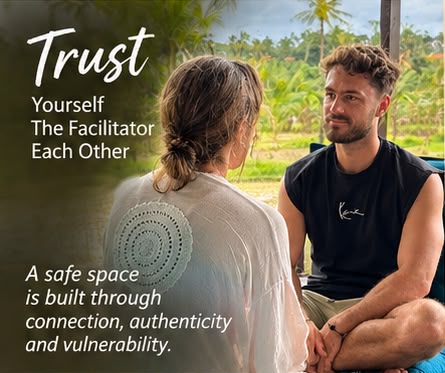
I see it as something that needs to be cultivated through three essential relationships:
* Trusting ourselves.
* Trusting the facilitator.
* Trusting the people around us.
All three matter.
1. Trusting ourselves
People need to feel connected to an inner resource, a place within themselves from which they can explore their emotions without being completely overwhelmed by them.
2. Trusting the facilitator
This is where authenticity and vulnerability become essential.
I don’t believe in facilitating from behind a mask of expertise or pretending to have everything figured out. I reveal parts of my own inner world. I share my experiences, my imperfections and my vulnerabilities.
Not to make the session about me, but to create permission for others to do the same.
When a facilitator is willing to be human, participants can begin to realise that they don’t have to perform, impress or pretend.
3. Trusting each other
This is perhaps the most underestimated element.
I use small interactions, authentic relating exercises and movement to help people connect beyond the superficial level.
I create space for everyone to feel heard, seen and appreciated.
Movement is particularly powerful because the body often tells another story than the words we use to describe ourselves.
Through simple exercises, people begin to reveal parts of themselves that might otherwise remain hidden.
They laugh, hesitate, express, make eye contact, feel awkward, become playful or allow themselves to be seen.
Little by little, the masks start to soften.
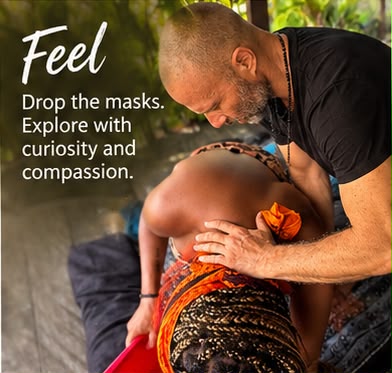
Strangers become human to one another.
And something shifts in the room.
Safety is no longer an abstract concept. It becomes an embodied experience.
From safety to Self energy
Once these foundations are established, I guide people towards connecting with their inner child.
But there is an important distinction here: I don’t want people to immediately dive into their wounded parts.
First, I want them to connect with what I call their Self energy.
In the language of Internal Family Systems (IFS), Self energy refers to a grounded, compassionate and curious state of being. It is associated with qualities such as calmness, clarity, confidence, courage, creativity, compassion and connectedness.
We all have different parts within us. Some carry fear, shame, sadness, anger or grief. Others have developed protective strategies to keep those feelings away.
The intention isn’t to get rid of these parts or fight against them.
It’s to develop a different relationship with them.
From a place of inner resource, we can approach our wounded parts with curiosity rather than judgement, compassion rather than rejection.
Instead of being consumed by our emotions, we can learn to be present with them.
Instead of asking, “What’s wrong with me?”, we can begin asking, “What happened to me, and what did I need to do to survive?”
This changes everything.
When the breath becomes spacious
And this is where the breathing itself comes in.
When people feel connected, resourced and safe, their relationship with the breath changes.
There is less pressure to perform, less need to achieve a particular emotional outcome and less resistance to whatever might emerge.
The breath becomes spacious.
The nervous system has more room to settle, explore and respond.
People can begin to approach emotions they’ve been avoiding for years, not because they are being pushed into an intense experience, but because they finally have enough internal and external support to meet those emotions.
Sometimes that means crying. Sometimes laughing uncontrollably. Sometimes expressing anger, feeling grief, experiencing joy or simply lying quietly and noticing what is happening inside.
There is no particular emotion that needs to be reached.
There is no performance.
There is no right or wrong experience.
And this is where the magic happens.
Not because everyone has a dramatic emotional release, but because people begin to experience themselves without having to hide, control or judge what they feel.
Integration: Breathwork is the prep work
There is a second essential component to transformation: integration.
I often describe Breathwork itself as the prep work.
The breathing experience can open doors, bring awareness to unconscious patterns and allow emotions to surface. But what happens afterwards is just as important.
In our integration circles, we listen to one another.
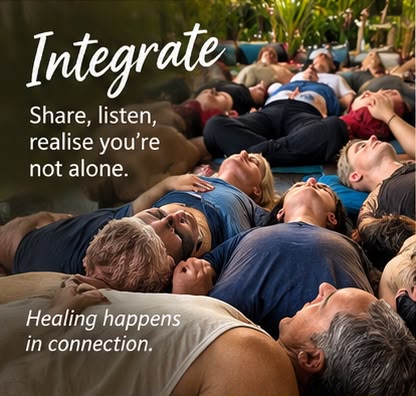
We share what happened, what we felt, what surprised us and what we discovered.
And something beautiful happens in that space.
We realise that we’re not so different from one another.
The person sitting next to us might be carrying the same fear, shame, insecurity or longing that we’ve been convinced was uniquely ours.
We realise we’re not alone.
Our burdens can be shared.
And instead of being judged, we are met with compassion, understanding and connection.
This is healing.
Not because someone fixes us, gives us advice or tells us how we should feel, but because we experience something profoundly different from what we may have experienced in the past: being seen exactly as we are and still being accepted.
The group becomes a mirror.
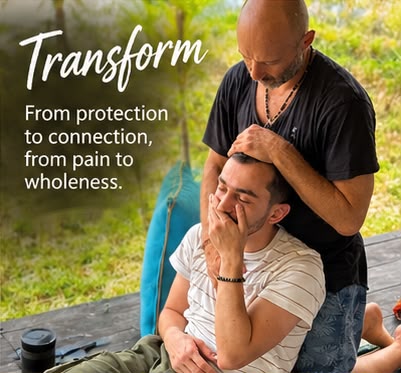
We begin to recognise ourselves in others, and others begin to recognise themselves in us.
What once felt isolating becomes something we can hold together.
Healing is returning to wholeness
For me, healing isn’t about fixing something that is broken.
It’s about returning to wholeness.
It’s recognising that there is nothing fundamentally wrong with me.
Things happened to me. I experienced situations that were difficult, overwhelming or painful. And in response, I developed coping mechanisms to protect myself.
But I am not those coping mechanisms.
I am not my fear. I am not my shame. I am not the mask I’ve learned to wear or the protective walls I’ve built around myself.
Those are parts of my story, but they don’t have to define my future.
When I can recognise these patterns, approach them with compassion and develop a different relationship with myself, I create the possibility of choosing differently.
I can stop living entirely from my conditioning and begin creating a different relationship with myself, with others and with life.
I can create my own reality.
It’s not about breathing harder. It’s about feeling safer.
If there’s one thing I’ve learned through years of facilitating Breathwork, it’s that the depth of a session cannot be measured by how intensely people breathe, how much they cry or how dramatic their emotional release is.
The real measure is how much permission people give themselves to be human.
To be vulnerable. To feel. To express. To be seen. To be accepted.
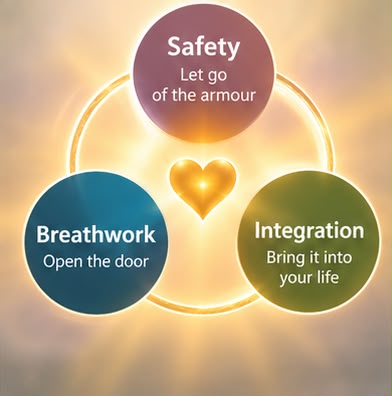
This is why I believe that safety and integration are the two pillars of transformational Breathwork.
Safety creates the conditions for people to put down their armour.
Breathwork allows them to explore what lies beneath it.
Integration helps them make sense of what they’ve experienced and realise they don’t have to carry everything alone.
And perhaps the greatest transformation isn’t that people leave feeling like someone new.
It’s that they leave feeling a little more like themselves.
Because the goal isn’t to become someone else. It’s to finally feel safe enough to be who you already are.
Join us in Bali or online: www.breathingcoldbali.com